Few Seats Left for BCA (Honours) – 2026
 - Registration Open
- SITM Courses
- Undergraduate (UG)
- Postgraduate (PG)
- SITM Events
- Hostel Facilities
- Sport Facilities
- Notices
- Photo Gallery
- Video Gallery
- Delnet Library Access

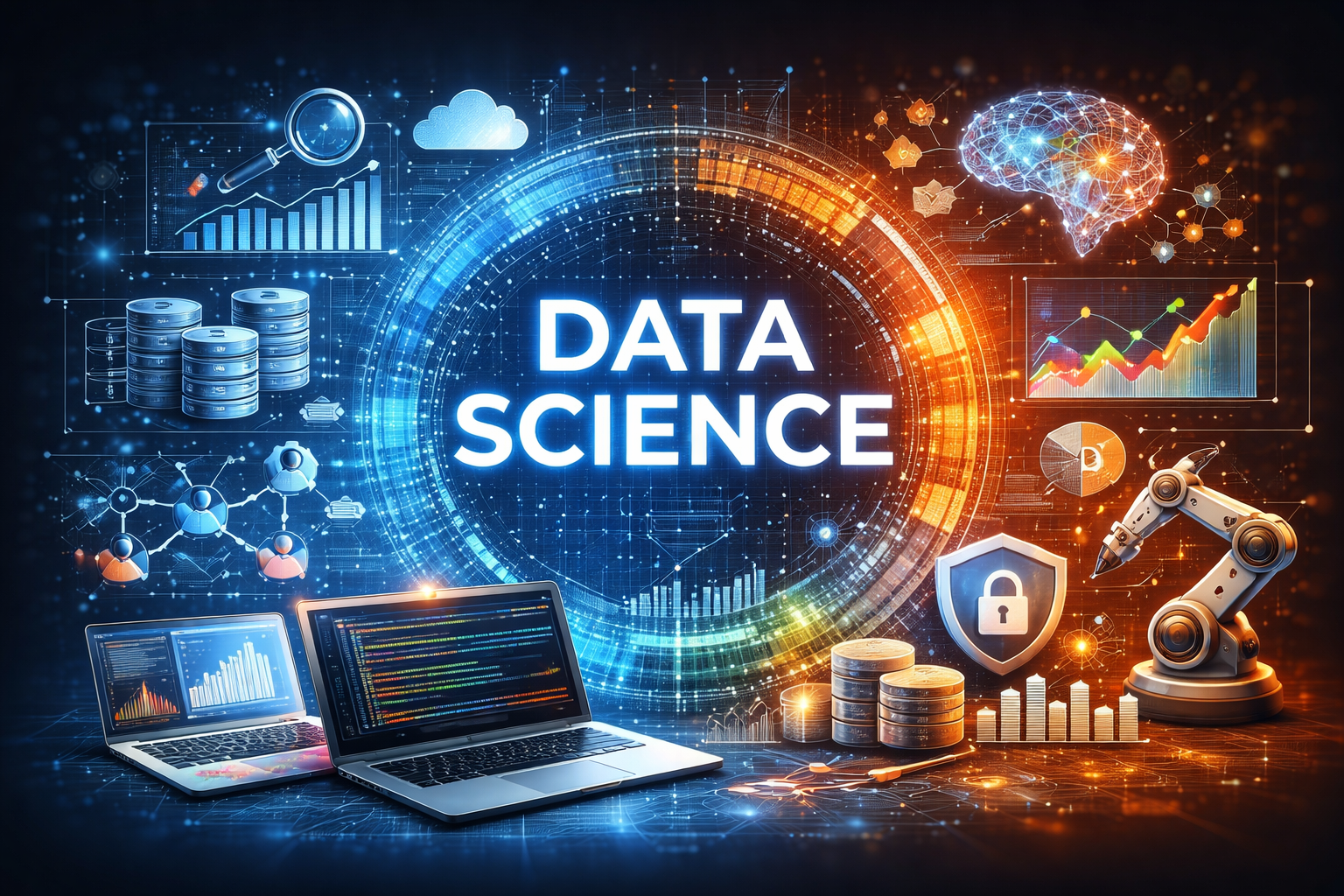
In an era defined by data, Data Science has become one of the most powerful and in-demand fields across the globe. Organizations today generate massive volumes of data every second, and the ability to analyze, interpret, and extract meaningful insights from this data is what sets successful businesses apart. Data Science serves as the bridge between raw data and informed decision-making.
Data Science is a multidisciplinary field that combines statistics, mathematics, programming, and domain expertise to extract knowledge and insights from structured and unstructured data. It involves collecting, cleaning, analyzing, and visualizing data to uncover patterns, trends, and relationships that can guide strategic decisions.
Data is gathered from various sources such as databases, sensors, websites, and applications. The quality of analysis depends heavily on the quality of collected data.
Raw data is often incomplete or inconsistent. This stage involves removing errors, handling missing values, and transforming data into a usable format.
Using statistical techniques and algorithms, data scientists explore datasets to identify trends and correlations.
Visualization tools like charts and dashboards help present insights in an easy-to-understand format for stakeholders.
Advanced models enable systems to learn from data and make predictions or automate decision-making processes.
Data Science helps in disease prediction, medical image analysis, and personalized treatment plans, improving patient outcomes.
It is widely used for fraud detection, credit scoring, risk management, and algorithmic trading.
Businesses use data science to understand customer behavior, optimize pricing, and provide personalized recommendations.
Institutions leverage data analytics to improve student performance, track progress, and enhance learning experiences.
Companies analyze customer data to create targeted campaigns and improve customer engagement.
Despite its advantages, Data Science comes with challenges:
The future of Data Science is incredibly promising. With the rise of Artificial Intelligence, Big Data, and cloud computing, the demand for data professionals continues to grow. Emerging trends such as real-time analytics, automation, and explainable AI are shaping the next phase of innovation.
Organizations that effectively leverage data science will be better positioned to adapt, innovate, and lead in a competitive environment.
Data Science is not just a technical field—it is a strategic asset that empowers organizations to make smarter decisions. By turning data into actionable insights, it enables businesses, governments, and institutions to solve complex problems and create value. As data continues to grow exponentially, Data Science will remain at the core of digital transformation.

05-Sep-2026
24-Mar-2026
24-Mar-2026

24-Mar-2026
02-Mar-2026
 Admissions Only